But Sugar is Sweeter

Latest

Strawberry Goat Cheese Salad

DSC01956
 

This past weekend, we had a little post-St. Patrick’s day celebration with some friends, and everyone was kind enough to bring something to go along with the corned beef sandwiches I made.  To be honest, I didn’t like the corned beef or the coleslaw topping enough to share the recipe, but I did get another delicious idea from this mini-potluck.  Our friends Lexi and Brad made a delicious salad with strawberries, goat cheese, almonds, and homemade poppyseed dressing.  It was so good that I have been thinking about it  since Friday!

I vowed to eat more fruits and vegetables this week, and what better way than with strawberry salad.  The part I liked the best was definitely the goat cheese. I’m a big goat cheese fan, but surprisingly enough I don’t know that I’ve ever put it on a salad.  Since it’s a very soft cheese, you can’t really chop it or shred it, but crumbling small pieces worked pretty well.  I chose to go with a raspberry vinaigrette for the salad because I wanted something super light, but the poppyseed was also delicious.  For the raspberry vinaigrette, I added Herbes de Provence, which is usually a mix of rosemary, thyme, sage, anise and lavender – but it varies a lot from mix to mix. In all honesty, at some point in the past, I was out of rosemary and in the middle of making dinner, so figured I’ve got this stuff ,and it has rosemary in it – I’ll try it.  Since then I haven’t actually  replaced my rosemary, I always just substitute Herbes de Provence – it just sounds so delightful, don’t you think?

Raspberry Vinagarette

  • 3 T.  Extra Virgin Olive Oil
  • 2 T. water
  • 3 T. Raspberry Balsamic Vinegar  (I even found this at Walmart)
  • 1 garlic clove, minced
  • 1/2 teaspoon Herbes de Provence or Rosemary (or 1 teaspoon fresh rosemary)
  • 1 tablespoon honey
  • Dash of salt and pepper

Wisk all ingredients until combined.

Strawberry Goat Cheese Salad

  • 4 cups spring mix salad
  • 1 cup of strawberries, sliced
  • 3 oz goat cheese, crumbled
  • 1/4 cup Pecans or Almonds (or both)

Place the almonds or pecans on a small baking tray and sprinkle with salt. Toast them under the broiler for a couple of minutes.  Be sure to watch them the whole time!  They go from toasted to burnt in about 2 seconds (speaking from personal experience).  Combine all the ingredients in a large bowl, and toss with raspberry vinaigrette.

*I don’t actually measure out how much of anything I put into a salad, so this is just a rough suggestion.

Cinnamon Raisin Swirl Bread

DSC01945

I really love baking.  It probably has something to do with the fact that I really love sweets, and sweets are generally baked.  It also has something to do with the fact that baking requires measuring and exactness – which oddly enough makes it a nice relaxing break from our everyday chaotic lives.  I like the idea that I can relax while at the same time doing something productive- and I have something to show for it when I’m done! The only problem with this is that one can only desserts so much.  If you would like to bake something, but fear (like me) that brownies will disappear in an embarrassingly short time, this bread would be the perfect choice.  This bread is perfect for slicing for breakfast and running out the door with.  I like it just plain, but John (of course) likes to add butter to it.

Like any yeast bread, it requires a lot of waiting around for the dough to rise – but each step actually takes very little time.  It’s really perfect to make on a day you were going to spend at home anyways.  It can make a nice  break from something monotonous (like studying) because after each step, you have to wait around for 40 minutes to an hour anyways.  I included step by step pictures, but only because they are fun, not to make this seem like it’s a really difficult recipe!  Each step is very simple.  The trickiest part is making sure to completely seal the loaf before baking – so that no cinnamon sugar mixture leaks out and burns on the sides of the pan.  This recipe makes 2 loaves, so you have one to give to a friend or freeze – but if you only want one, it can easily be halved.  When freezing this bread, I wrap it in aluminum foil, and then place it in a freezer bag, and it freezes wonderfully.

Cinnamon Raisin Swirl Bread

Makes 2 standard (9×5) loaves

For the dough:

  • 2  1/4 tsp. instant yeast (or 1 packet)
  • 2 cups warm milk (~105-110˚ F)
  • 34 oz (6 1/2 cups) all-purpose flour plus more for dusting
  • 8 Tbsp. unsalted butter, softened
  • 1/2  cup sugar
  • 2 large eggs
  • 3 tsp. coarse salt
  • 3 tsp. ground cinnamon
  • 1 cup raisins
  • Cooking spray

For the filling:

  • 1 1/2 cups sugar
  • 2 Tbsp. ground cinnamon
  • 1/4 cup water
  • 1 egg, lightly beaten

Start by combining milk and yeast in the bottom of a stand mixer fitted with the dough hook attachment.  Add the flour, softened butter, sugar, eggs, salt, & cinnamon.  Turn the mixer on low speed (2), and knead the dough for 3-4 minutes.  Add the raisins and continue to knead for 3-4 more minutes.  The dough should be smooth and clear the sides of the bowl.  If it is too sticky to handle, add a little bit more flour and knead for a few more minutes.

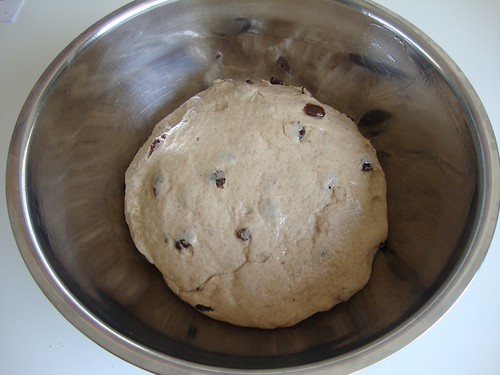
Remove the dough from the mixing bowl, and place in a large bowl coated with cooking spray.  Turn the dough over to lightly coat the outsides with oil.  Cover with plastic wrap or a kitchen towel.  Place in a warm, draft free place and let the dough rise for about 1 hour, or until doubled.  I like to put mine inside a turned-off oven.
DSC01916

Take the dough out and divide into 2 equal pieces.  I weighed mine using a food scale, but if you don’t have one you can just eye ball it.
DSC01927

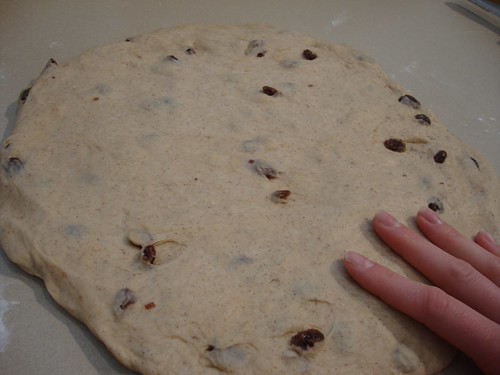
Working with one piece of dough, flatten it into a circle using your palms.
DSC01931


Then fold the dough into thirds, like a letter.
DSC01932

Then fold again into thirds, the opposite direction.  The purpose of this is 2 fold.  First of all, it basically serves as a very gentle kneading, which releases any gas built up in the dough, and gives the yeast access to new nutrients.  But do not “knead” the dough, or over-handle it -because this will destroy the gluten strands that give the bread it’s airy and light weight texture.  Secondly, this method helps to shape the dough into a rectangle, which is helpful in the next step.
DSC01933

Once each loaf is folded, place them seam side down in an bowl coated with cooking spray.  (Each loaf should get it’s own bowl at this point.) Cover with plastic wrap or a towel, and allow the dough to rise for an additional 45 minutes.
DSC01934

Once the dough has risen for the second time, roll out one ball of dough into a 15×11 inch rectangle.
DSC01936
In a small bowl combine the sugar, water and cinnamon.  Brush the rectangle of dough with the slightly beaten egg, and then spread about half of the cinnamon sugar mixture over the rectangle, leaving a small border at the edges.  (If you want to be very exact, you can mix 3/4 c. sugar, 1 T. cinnamon, and 2 T. water for the first loaf, and then do this again for the second loaf.) *Note: if you add too much water to the cinnamon sugar mixture (which I have done before), it will seep out of the loaf, and create a burned sugar crust to your bread.  So while mixing together the sugar-err on the side off too little water. The amount in this picture is a little too liquidly.

DSC01940

Fold in about one inch of the edges of the dough, in order to seal the cinnamon-sugar mixture in.

DSC01941

Starting with the unfolded edge of the dough, roll dough into tight log.  Press gently as you roll to ensure the dough is sticking to itself – this will help prevent the cinnamon sugar mixture from seeping out.
DSC01942

Once the dough is rolled, pinch the edges of dough together tightly.  Use some water to make sure the dough adheres.
DSC01943
Place dough seam side down in a heavily greased 9×5 inch baking loaf, and repeat with remaining roll.

Cover each loaf pan with a towel or plastic wrap, and let rise again for 40 minutes so that the dough just rises above the edge of the pan.

Preheat oven to 425 degrees. Brush the remaining egg over the top of each loaf in order to give it a shiny, finished appearance (I didn’t do this for this loaf, hence the less than perfect surface).  Loosely tent a piece of aluminum foil over the top of each pan, to prevent the top from over browning.

Place loaves in the oven and bake for 45 minutes.  20 minutes into baking, remove the foil “tent” to allow the surface to brown. Remove from the oven, allow to cool slightly and then remove from pan and cool on a cooling rack.

DSC01947

Recipe found at Annie’s Eats, and originally from Martha Stewart’s Baking Handbook

Twice Baked Potatoes

DSC01899

In honor of St. Patrick’s Day, I figured what would be better than a POTATO with the colors of the Irish flag!   I made mine with  broccoli, scallions, and cheddar, so I could get the green, white and orange effect.   I hope this brings a little St. Patrick’s Day spirit to your day!

My better half is interviewing people this week,  so it’s just me here until tomorrow.   Cooking for 1 can be tricky, but I think this recipe fits the bill – It’s quick, easy, and I had all the ingredients on hand.  The recipe is for 4 potatoes, but can easily be adapted to make just 1, or 8.  I often forget how great a good baked potato can be.  In college, my friend Christine, once had a “Baked Potato Party” in which she baked a bunch of potatoes, and then had all kinds of fun toppings for us to put on them.  It was such an easy and creative idea, and I have been wanting to do it ever since – maybe this will inspire you to host your own.  Whatever you put on your baked potato, it can be a hearty, and filling meal that’s easy and cheap to make.  I also included some suggestions for alternate stuffed baked potatoes , which I am now dying to try!

Twice Baked Potatoes

  • 4 russet potatoes – scrubbed and patted dry
  • Olive Oil and Salt
  • 1 cup sharp cheddar cheese, shredded
  • 3/4 cup light sour cream
  • 1/4 cup skim milk
  • 1 teaspoon garlic powder
  • 3/4 cup chopped broccoli, steamed
  • 1/2 cup chopped scallions

Preheat oven to 400°.  Rub potatoes with a small amount of oil and sprinkle with salt.  Place potatoes directly on rack and cook for 45-60 minutes.  Do not wrap potatoes in foil because this will make the skins soft and it will be difficult to scoop the filling out later.

In a large bowl combine 1/2 cup of cheddar cheese, sour cream, milk, garlic powder, broccoli, and 1/4 cup scallions.

Remove potatoes from oven and let cool slightly.  Cut the potatoes in half lengthwise. Using a soup spoon, scrape out as much potato as you can while leaving the skin intact – leaving about 1/8 inch.  The potatoes taste better when there is less plain flesh left in them.  Add the flesh to the large bowl with sour cream mixture.  Mash the flesh until combined.

Spoon the flesh back into the potato shells.  Place filled shells on a baking sheet coated with aluminum foil.  Sprinkle remaining cheddar cheese over the tops of the potatoes.

Return potatoes to the oven for 10-15 minutes or until cheese is melted and starting to brown.

To serve, top with remaining scallions.


Variation 1: Blue Cheese, Onion and Mushroom Potatoes

  • Substitute 1 cup crumbled blue cheese for the cheddar, and 1 cup sautéed mushrooms and onions for the broccoli.

Variation 2: Goat Cheese & Caramelized Onion Stuffed Potatoes

  • Substitute 1 cup of herbed goat cheese for the cheddar, and 3/4 cup caramelized onions for the broccoli.

Variations inspired by America’s Test Kitchen Healthy Family Cookbook

Royal Icing – Recipe and Tutorial

IMG_1877


IMG_1879

So maybe St. Patrick’s day isn’t considered a major holiday for most people, but those people didn’t grow up in my family.  In my (half) Irish family, St. Patty’s day is probably the next  big holiday after Thanksgiving and Christmas. I had been wanting to decorate St. Patty’s day cookies pretty much since I finished the Valentine’s Day ones. It worked out perfectly,  because my festive mother was here to help me  decorate them!  I mentioned earlier that I really wanted to try to get good enough at royal icing to post a “How to” – and I think I have just about reached that point.  I’ve made it enough times now that I have it down to a science.  It’s kind of addicting, so be careful.  My mom and I are already planning next year’s St. Patty’s Day cookie decorating, and we were even brainstorming about Easter….

A lot of people wonder – “Why use royal icing?….Doesn’t buttercream taste better?”. And I’ll say, yes if you are eating icing by itself, buttercream is definitely the way to go – but with a buttery cookie underneath royal icing adds a perfect amount of sweetness without being too rich. Plus the royal icing seals in the moisture of the cookie, so your cookies can be made ahead of time, and will last a lot longer. More importantly, it’s just not possible to decorate with buttercream the way you can with royal icing. Ever wonder how professional cookies get that completely smooth surface with multiple colors and no “spread marks”? That’s right – they use royal icing.

So here’s the recipe, followed by a long tutorial.  I tried to include as many pointers as possible, but for the most part you can figure out what to do looking at the pictures.

Royal Icing

  • 4 cups Powdered Sugar (About 1 Pound)
  • 2 Tablespoons Meringue Powder
  • 5 Tablespoons Water (to start)

Combine all ingredients in the bowl of a stand mixer.  Mix on low (Speed 2 or 4) for 7-10 minutes, or until the sheen has disappeared and the icing has a matte appearance.   It will be too thick to use at this point so you will be adding more water later; however, getting it to this texture makes a difference in the final product.

How to Decorate with Royal Icing

  • 1 -2 batches of Royal Icing and Sugar Cookies
  • Small plastic containers with lids
  • Pastry Bags (I like disposable so you don’t have to clean them)
  • Couplers and Decorating Tips  (I use size 3)
  • Toothpicks
  • Gel Food Coloring
  • Miniature Squeeze bottle (optional)

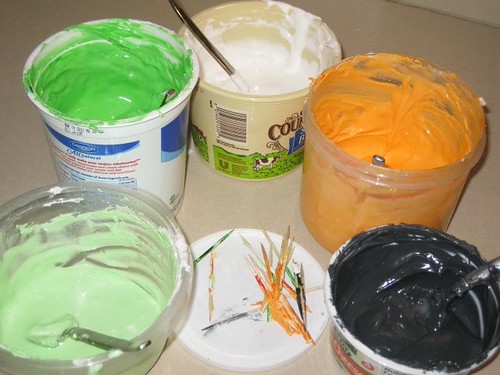
First, start by planning out what colors you will want to use, and how much of each.  For these cookies, I made 5 colors: Green, Light Green, Orange, Black, and White.   According to color need, divide the white icing into the containers.  Add about 1 additional teaspoon of water to each container.  Stir to incorporate.  You may need to add another teaspoon or 2 in order to get a good consistency for piping.  The key is to get the icing thin enough that you can easily pipe  a smooth line, but thick enough that the icing will still dry quickly.
IMG_1811

Using toothpicks, add a little bit of gel food color and stir with a spoon.  Continue adding color until you achieve the desired tint. For dark colors, like black or red, you will need a lot of gel.
IMG_1819

Prepare your pastry bags by cutting about 3/4 of an inch from the tip. Place the coupler inside the bag, and secure the appropriate tip.  I prefer size 3 for edging the cookies, but I used a mix of sizes 2-4, because that’s what I have.  If you do not have pastry bags and tips , you can try using a ziploc bag and cutting the corner to make a VERY small hole.  I only spent about $10 for all the couplers, tips and bags, but if you are only going to make these once, it might not be worth it.
IMG_1822

Fold down the edges of the pastry bags, and using a spoon or knife, scoop the icing into the pastry bag.  You only need a very small amount of icing to edge the cookies, but I think it’s easier to work with if you have a moderate amount of icing in the bag.   Also, it’s easy to simply  squeeze the left over icing back into the original container when you are finished.

IMG_1841

Pipe the icing around the edges of each cookie to make an outline. To get the smoothest line possible you do not want the tip to be touching the cookie.
IMG_1839
IMG_1848
I think it’s better to work quickly and let the icing lie smoothy, than to try to get an absolutely perfect shape for the outline. If you look at these, some of the cookies have a smoother outline, and some are more squiggly.
IMG_1850

Once the cookies are lined, squeeze unneeded icing back into the container.  Now it’s time to thin the icing for flooding.  Add 1 teaspoon water at a time to each icing, stirring after each addition.  You want the icing to be thin enough that when a spoonful of it is poured back into the container, it takes about 4 seconds for it to disappear into the pool of icing.   It is better to err on the side of too thick of icing than to thin.  If you accidentally make the icing too thin, add a little bit of powdered sugar to get it back to a normal consistency.
IMG_1847

You should now let the icing set for about 5 minutes in order to get the air bubbles to rise to the surface.  The first time making this, I didn’t do this, and you end up with air bubbles on what was supposed to be your smooth surface cookie.  Once the air bubbles have risen to the surface, gently stir the icing through once, just to pop them.
IMG_1846

If you are using mini squeeze bottles, this would be the time to transfer the icing into the bottle.  It’s easier to do if the icing is in a flexible plastic container, because you can bend the container to funnel the icing in.  This was my first time using squeeze bottles, and it does make it a lot easier to flood the cookies, but it also makes one more thing to clean when finished.
IMG_1851
IMG_1857

Now flood the cookies.  If you are using squeeze bottles, just squeeze it around the edges and move inward to fill the cookie in.
IMG_1859

IMG_1862

If you are not using squeeze bottles, spoon the icing onto the top of the cookie, and then spread it to the edges using a toothpick.  2 pointers: 1) If you spread the icing over just over the edge of the piping, it will help to blend the piping with the flooded icing.  2) It looks a lot better if you over-flood the cookies, so that the icing ends up creating a dome look on top of the cookie.  If you under-fill them, the center will sink down and the outer edge piping will be very visible.
IMG_1863

IMG_1865
If you want to decorate the cookies with sprinkles, as I did with the pots of gold, it’s best to put this on while the icing is still wet.  If you want to pipe a design on top of the cookies, it’s best to let the cookies dry for at least 45 minutes (or overnight).  For the “plaid” effect on the cookies, I cleaned up while letting the cookies dry, and I just used the little bit of icing I had left in my pastry bags and piped perpendicular lines over several cookies in a row.

IMG_1894

Let let the cookies dry for several hours or overnight before packing them up. The cookies should then be stored in an airtight container or cellophane bags.  These cookies will last for at least a full week, and  once the icing has dried, it is very sturdy.  Therefore these cookies can be made in advance and are great for mailing.
IMG_1898

Inspired by Annie’s Eats

Panko Crusted Salmon

 
DSC01886
Back on the homefront, I’m trying to make the best out of my last 3 days of my last spring break…ever!  Because THE BOARDS are looming over our heads, I’m not really sure if I’ll be able to make it home for a visit before July – so my Mom decided to make the trek here to visit! Unfortunately, the weather was really awful in Cleveland (so much for spring), but my Mom’s a brave lady, and she tackled the snow to make the drive to Toledo.  I’m really glad she did because we had a lovely day “fliting” around, and of course I wanted to make a special dinner for the evening.

This dinner exceeded my expectations.  I knew I wanted to make salmon – but salmon is such a hearty fish that I have trouble deciding what to do to make it special without overpowering its great flavor.  While visiting my favorite “club” – Costco – I was flipping through Ina Garten’s new book, and saw a recipe using Panko with Salmon.  Because I have also really been wanting to use Panko, I thought this would be the perfect opportunity to try it.  I didn’t buy the book, so this is my own adaptation.

It turned out to be really easy but it tasted, and looked gourmet (win-win!)  I loved the lemon zest in the crumb coating, and you definitely shouldn’t skimp on it. I also think that salmon is one of the fish that you need to be careful to buy “Wild Caught”.   It’s a little more expensive than the farm raised, but it’s a lot healthier and has a better flavor.  For some fish – it doesn’t really matter, but salmon is not one of those fish. Panko crumbs can be found in any local grocery store, usually near the Asian food.

Panko Crusted Salmon

Serves 4-5

  • 1 lb Wild Caught Salmon filets
  • 3/4 cup Panko
  • 1/4 cup finely chopped parlsey
  • zest of 1 large lemon (or 2 small)
  • 2 Tablespoons Olive Oil
  • 1 Tablespoon Dijon Mustard
  • 1 Tablespoon Mayonaise
  • Salt & Pepper

Preheat oven to 375 degrees.

In a small bowl combine the Panko, parsley, lemon zest and olive oil.  Stir until well blended and Panko is evenly coated with olive oil. In an even smaller bowl, mix together 1 T. each of Dijon mustard and mayonaise.

Place salmon filets on a baking sheet coated with aluminum foil.  Sprinkle evenly with salt and pepper.  Spread the Mayonaise and Dijon mixture evenly over the filet.  Sprinkle the Panko crumb mixture evenly over the fish.  The mustard mixture should help the coating to stick, but press to adhere.

Bake the salmon for 10-15 minutes (Using a 1 inch filet 15 minutes was good for me).

Serve with lemon wedges.  Also good with rice pilaf and roasted asparagus.


Inspired by How Easy Is That? by Ina Garten.

Pirouettes AKA Cigarettes Russes

DSC01880
So I finished my test (yeah!) and  as it turns out, blogging actually helped my grade – so I think its safe to continue!  Almost immediately after the test, we left for Taos, New Mexico.  We had a great visit with my in-laws, ate and drank well, and even got some skiing and hiking in.  Apparently we brought the bad weather with us, but it was still better than the cloudy skys we came back to in Ohio.  I was planning on taking a break from cooking while on vacation – but of course I got the urge to bake after about 10 hours.  Actually I’ve had the urge to bake these particular cookies for several weeks.  I kept putting them off because they looked kind of complicated,   but spring break seemed like the perfect time to try these out!

The reason I have been wanting to make these cookies for so long, is that you really can’t buy them anywhere!  Sure, you can buy filled Pirouettes, but I like the plain and simple taste of just the wafer – without hazelnut, mint, or chocolate cream inside to ruin it.   Pepperidge Farm does actually make the simple “Cigarettes Russes” (without the filling), but the only place I have ever seen them is inside of the entertaining pack of assorted cookies, and even then you only get like 2! So while I really did enjoy making these cookies, there was also a utilitarian reason for making them.

I actually tried making these twice.  The first time they did not work out …at all.  I’m going to blame it on the 7,500 altitude in Taos, NM, but honestly I think there were a bunch of factors that caused the initial demise of these cookies.  The second time was much better, and now I know the specifics of how to make them perfect – and lucky for you, I’ll share that info with you :-)!

Cigarettes Russes

  • 6 Tbs. (3/4 stick) softened butter
  • 1 cup powdered sugar
  • 4 egg whites at room temperature (the first time I took them straight from the fridge – which didn’t work)
  • 2 tsp. vanilla extract
  • 2/3 cup all-purpose flour
  • 1/8 tsp. salt.

1. Preheat an oven to 425°F. Line 2 large baking sheets with silicone liners. (Do NOT use Parchment.  If you don’t have silicon liners you could try a greased cookie sheet, but this didn’t work as well for me)

2. In the bowl of an electric mixer, using the paddle attachment, beat the butter on high speed until fluffy and pale yellow.
3. Gradually add powdered sugar and continue beating until well blended.
4. Add the egg whites, one at a time, beating well after each addition.

5. Add the vanilla and beat until blended.

6. Mix flour and salt together, and gradually add to buter mixture.  Stir to combine.

7. Using a small cookie cookie scoop, drop the batter  onto a prepared baking sheet, forming only 4 cookies.  You can only do 4 at time because the cookies must be rolled quickly before they cool.

DSC01866

8. Moisten a spatula, and using a circular motion, spread batter into an oval/circle.  The cookies need to be even, but the thinner you can make them, the better they will turn out.  Mine ended up being about 4×4 inches.

DSC01868

9. Bake the cookies until just golden at the edges – about 3 minutes.   If your batter is not spread evenly, the edges will brown too quickly.
10. While the first batch cooks, prepare a second batch on the remaining sheet.  I actually thought it worked well when the cookie sheet was still warm from the previous batch.
11. Remove the baked cookies from the oven, and quickly remove one cookie using a thin spatula. Wrap the cookie around the thin handle of a wooden spoon.  Slighly greasing the handle with cooking spray will help if the cookies are getting stuck to the spoon.

DSC01870

12. Remove the cookie from the spoon handle and place on a wire rack.  Repeat with remaining 3 cookies.  If the cookies begin to harden before you can shape them, return to the oven for 30 seconds to soften.
13. If your cookies are not as crisp as you would like, place them on a wire rack in a 250 degree oven for 5-10 minutes.  This will help suck the remaining moisture out of the cookies.

Chocolate Dip

  • 3 oz semisweet chocolate
  • 1 tsp  butter
  • 1 tsp corn syrup (if you have it – I didn’t so I didn’t use it)
In a double boiler,  combine the chocolate, butter and corn syrup. Set over barely simmering water in the bottom pan and stir until melted and blended. Let cool slightly. Dip about 1 inch of each cookie into the chocolate. Place on waxed paper, on tope of a wire rack, until set.
Makes about 36 cookies.

Adapted from Williams Sonoma

Stuffed Green Pepper Soup

DSC01806

If you start taking pictures of the food that you cook at home, it doesn’t take long to realize that a lot of homemade meals are just not that photogenic.  Unfortunately, we don’t eat cookies, cupcakes and sushi all the time .  But I don’t want to fall into the rut of only posting things that turn out pretty – because, well that would mean I’d be making (and eating) an awful lot of baked goods.  Plus, I wanted this blog to be a mix of everything that is good to eat.  Hopefully, if my photography skills improve, I’ll be able to make even “un-photogenic” foods look as delicious as they are.  But for now, you’ll just have to trust me.

This soup doesn’t look like much, but I really love it.  This week is “test week”, so I can pretty much assure you that If I get around to posting anything,   it will be easy to make.  I like to use cooking as a break from sitting, all alone, in the room that John and I like to call “The Dungeon”.  But during a really busy week, being away from my books for more than an hour starts to stress me out.  So sometimes, I just bring my books with me, to the kitchen, or the gym, or the couch… But seriously, this dinner takes about 15 minutes of prep and packs a lot of flavor.  It’s a lot less work than actually stuffing green peppers, but it’s very hearty and will warm you up on a cold winter night.   Really it’s not a “soup” in the sense that you could probably eat it with a fork if you’d like, but there was really not another word to use to describe it.

Stuffed Green Pepper Soup

Makes about 4 servings

  • 1/2 lb. lean ground beef
  • 2 green peppers, seeded and chopped (about 2 cups)
  • 1 cup chopped onion (about 1/2 a large onion)
  • A dash of crushed red pepper & a Pinch of black pepper
  • 1 can (14.5 oz) diced tomatoes, undrained
  • 1 can (10.75 oz)condensed tomato soup, undiluted
  • 1 can (14.5 oz) of low sodium beef broth
  • Hot white rice (I usually make 3-4cups of rice – it’s cheap and I’d rather have more than enough)

In a dutch oven, over medium heat, cook the ground beef for 3-5 minutes, or until brown and crumbly.  Add the green pepper and chopped onion and cook for about 8 minutes or until slightly softened.  Add a dash of crushed red pepper (or more if you like spice) and a pinch of black pepper.  Pour in the can of tomatoes, tomato soup and beef broth.  Bring to a boil.  Reduce heat and simmer, covered, for 45 minutes.  Serve over hot white rice.

Barely adapted from Cooking Light

Red Beans & Rice

There are 3 reasons why I really wanted to make this dish: First, although I really thought spring was on its way (and was planning dinner accordingly),  I was quickly thrown back to reality when I found my  car crystalized in 2 inch thick ice. After finally digging my car out from under the snow/ice mix, I decided that a warm, hearty, wintery meal was in order.  Second, Mardi Gras is fast approaching, and it really makes me miss Louisiana and the friends I made there.  Louisiana is probably the most cultural place in America, and they sure know how to cook.  And third, my friend Maggie, just bought a crockpot and I promised her a good “Crock Pot” recipe.

Likely your reasons for making this dinner are going to be different than mine, but I think you should find your own reasons, and make this.  This isn’t one of those crockpot meals where you have to cook everything before you put it into the crock pot (I never got the point of that), so it’s quite simple to make. In fact, when I had the cutting board out for dinner the night before, I just cut up the ingredients,  and then John threw them in the crockpot this morning.  But just because it’s simple doesn’t change the fact that it’s delicious.  You know what would make this dinner even more delcious?  King Cake! If you live in Louisiana, please go eat a king cake for me, and then tell me all about it (preferably one with cream cheese and strawberry filling).  Oh how I miss you Louisiana and your sweet, sweet food and drink and people.

Red Beans and Rice

  • 1 pound Dried Red Beans, rinsed and drained
  • 7 cups Water
  • 1 whole Green Bell Pepper, Chopped
  • 1 whole Onion, Chopped
  • 3 stalks Celery, Chopped
  • 3 cloves Garlic, Finely Chopped
  • ½ pound Turkey Polska Kielbasa, sliced (or Andouille Sausage)*
  • 3 Tablespoons “Tony’s” or other Creole Seasoning
  • Hot Cooked Rice

* If you want the real thing, you should go with the real sausage.  I happen to like turkey sausage, but it’s not going to give you quite as thick of a sauce.

Rinse and drain the red beans. Place all the ingredients into a large Crock Pot, except for the rice.

Cook, covered, at HIGH for 7 hours or until beans are tender.  Don’t peak.

Serve over hot white rice.  I also made this cornbread to serve with it.  (Krusteaz didn’t pay for me for this or anything,  but I just thought it was a really good box mix, and it was only $1)

Adapted from  Tasty Kitchen

Chicken Enchiladas Verdes

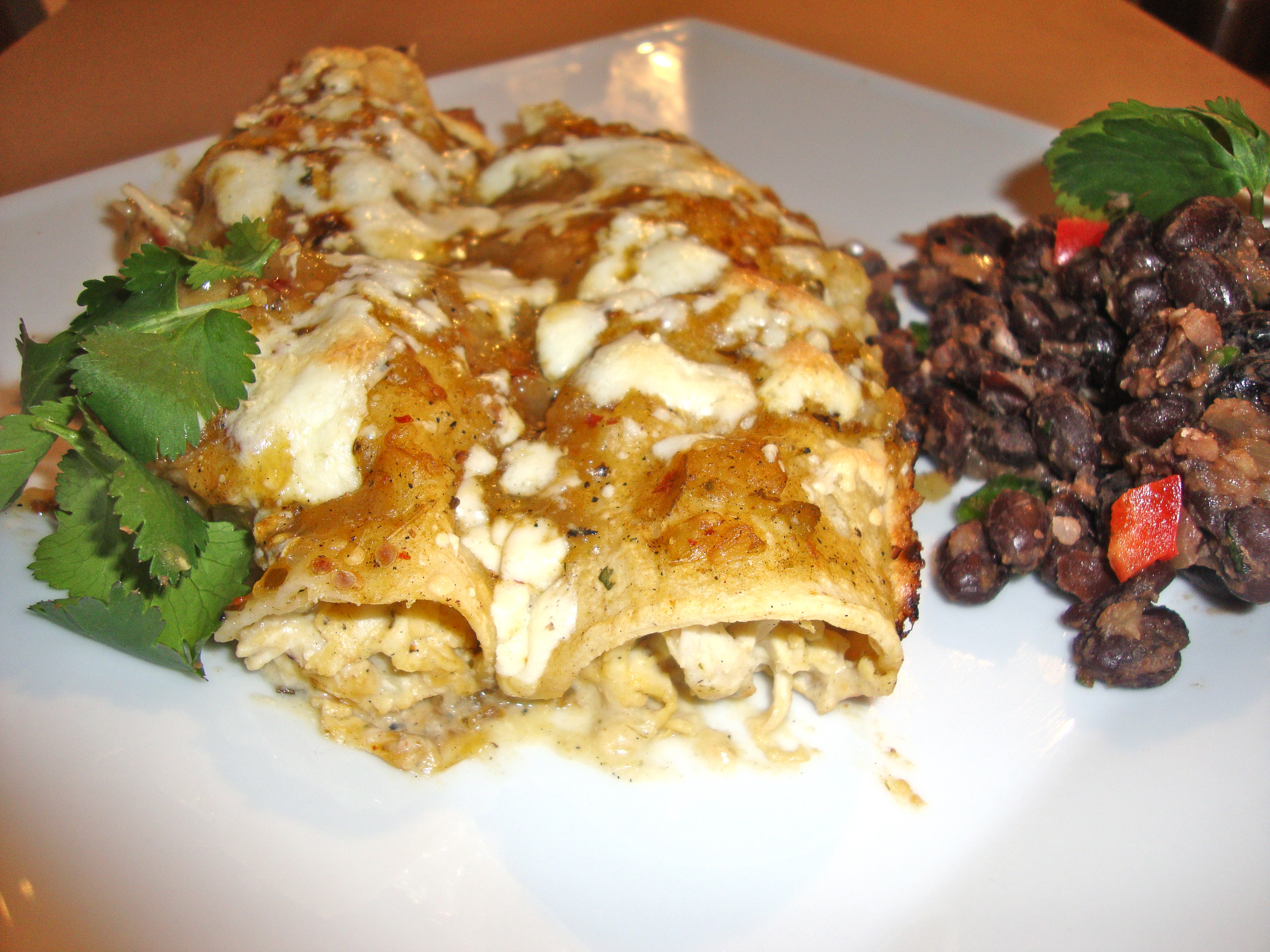
To be honest, I’ve been eating the “verde” version of enchiladas for so long, that I kind of forgot there was any other kind. But that’s perfectly fine with me, because I love this dinner.  Its great because so many different cuisines are made using a red tomato base, so this really adds some variety to the dinner table. I made a similar version for the first time back in college (Friday night dinner parties!), and I’ve been adapting it ever since.  At this point I’m even afraid to order enchiladas at a Mexican restaurant, for fear that they won’t live up to this version.

I thought about making the  verde sauce from scratch,  but I couldn’t find tomatillos at the store. (Probably had something to do with being the middle of the winter in Ohio). But it’s probably better that I didn’t because this dish is great just the way it is, and I have enough other things to keep me busy.  For the cheese topping,  this time I happened to use  queso fresco, but I have made it before using Monterey Jack, and I like both.  It just depends on what I find at the store and what happens to be on sale.

Chicken Enchiladas Verdes

– Makes about 8 enchiladas

  • 1 can (10 oz) green enchilada sauce
  • 1 bottle (14 oz) salsa verde (or about 2 cups)
  • 1/2 an medium onion, minced
  • 2 cloves garlic, minced
  • 1  large (12 oz) chicken breast (or 2 smaller) – pounded to an even thickness
  • 1/2 block (4 oz) reduced fat  cream cheese
  • 1/4 cup finely chopped fresh cilantro
  • 8 corn tortillas (about 6 inch)
  • 1/2 cup crumbled queso fresco or Monterey Jack cheese

Add the canned enchilada sauce, salsa verde, minced onion, and garlic to a saucepan over medium heat.   Add the 1 or 2 chicken breasts to the saucepan, cover pan, and cook for 20 minutes. Cut the chicken in half to ensure it is cooked through, and if not, continue cooking until it is no longer pink.

Turn off heat, and remove chicken from the pan.  After cooling slightly, shred chicken into small pieces.  In a small bowl combine the chicken, cream cheese, 2/3 cup of enchilada sauce and cilantro.

The salsa mixture should still be warm at this point.  Working with one tortilla at a time, dip the corn tortilla into the salsa mixture for about 10 seconds and remove with tongs.  This is just to make the tortilla more pliable, so it doesn’t crack when rolling.  Then place the tortilla on a plate and spread 1/3 cup of chicken mixture down the tortilla.  Roll up and place, seam side down, in a 11 x 7 baking dish coated with cooking spray.  Repeat with remaining tortillas.

Pour a heaping cup of remaining salsa mixture on top of the tortillas.  (I usually have some left over, but I prefer this to using 1/2 a can of enchilada sauce. If you want to double this recipe, I would just use an extra jar of salsa and skip the canned sauce). Top with crumbled queso fresco or shredded Monterey jack (or both).

Bake at 425° for 15-20 minutes, or until cheese melts and enchiladas are heated through.

Spinach Lasagna

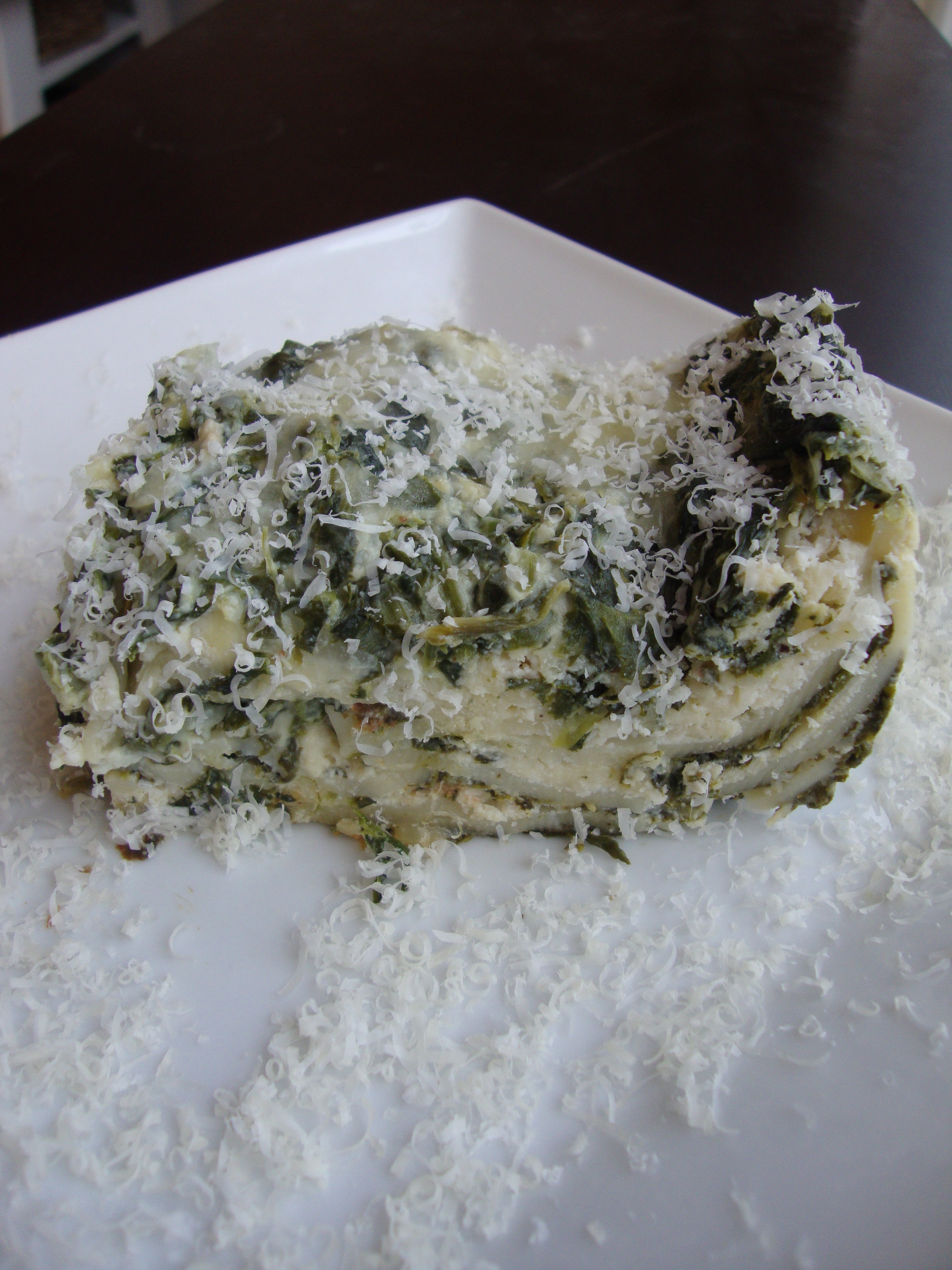
The worst part about the first 2 years of medical school is that most of your time is spent studying alone. Despite the fun pictures on Facebook, we don’t actually get to hang out together that much.   To try to remedy this situation, John and I decided to have a little “Lasagna Party”.  It was a good excuse to get together with all of our friends, including the newest “member”- Baby Zoe!  We have some diverse tastes in our group, so we had quite a lasagna selection: Spinach Lasagna, Lasagna with a a beef and sausage sauce, and Lasagna made with chicken sausage.  It was quite a feast!

Of all the lasagna choices, this spinach lasagna was probably the healthiest. (Not quite sure I can call it healthy – it’s still lasagna after all).  But in general, the cream sauce used in spinach lasagna usually makes it much more fat and calorie laden than it’s meat and tomato counterpart.  However, I found a recipe that didn’t use cream, and used non-fat ricotta, to make this a healthier and much reduced fat version.  At first I was skeptical that this lasagna would just taste like a lowfat version of the real thing, but I was very pleasantly surprised.  I don’t think anyone would’ve guessed that this was “reduced fat”, and it was really quite easy to put together (it does take some time though).

Spinach Lasagna

– Makes a 13 x9 dish to feed 8-10 people.

  • 2 cups nonfat ricotta (16 oz)
  • 2 1/2 cups shredded mozzarella (about 10 oz)
  • 1 grated parmesan cheese (2 oz)
  • 1 large egg, lightly beaten
  • Salt and Pepper
  • 2 tablespoons Olive oil
  • 1 onion, minced
  • 8 garlic cloves, minced
  • 1/4 cup all purpose flour
  • 5 cups 1% milk (I used skim milk and substituted  about 1/4 cup cream)
  • 2 bay leaves
  • 1/2 teaspoon ground nutmeg
  • 3o ounces (3 packages)  frozen chopped spinach, thawed and squeezed dry
  • 12 lasagna noodles

1. Heat a large pot of water over high heat.  Season with salt and olive oil.  Add lasagna noodles to water and cook for about 9 minutes. (It’s better to undercook the noodles slightly.).  Drain,  and lay noodles onto paper towels to dry separately.

2. Combine ricotta cheese, 1 1/2 cups mozzarella, 1/2 cup parmesan, slightly beaten egg and salt and pepper in a bowl.  Stir to combine, then set aside or refrigerate for later assembly.

3. Heat 2 T. oil in a large skillet over medium. Add onion and cook to soften (about 5 minutes).  Add garlic and stir until just fragrant (30 seconds).  Add flour and cook for about a minute (cook it just enough to eliminate the raw flour taste, but do not brown.)

4. Slowly whisk in all 5 cups of milk and 2 bay leaves.  Simmer, while stirring occasionally, for 10 minutes.  The sauce should thicken slightly.

5. Remove from heat, and remove bay leaves.  Stir in spinach, nutmeg, and remaining (1/2 cup) parmesan. Season with salt and pepper.

6. Preheat oven to 375 degrees. Coat a 13×9 inch pan with cooking spray.

7. To assemble: Place a heaping cup of spinach sauce on the botton of the 13×9 inch pan.  Layer 4 noodles, overlapping, on the bottom of the pan.  Spread about 1 cup of ricotta mixture over the noodles.  Top with a heaping cup of spinach sauce.  Repeat 2 more times, ending with ricotta and spinach sauce.  The top layer should have 2-3 cups of spinach sauce poured over top.  Top with remaining 1 cup of mozzarella cheese.

8.  Cover with foil and bake for 40 minutes.  To avoid spills you can place the lasagna dish on a large baking sheet lined with foil (I didn’t do this because I didn’t have space in the oven). After 40 minutes, remove foil and continue to bake for 20 minutes.  Cool slightly before serving.

Recipe adapted from America’a Test Kitchen Healthy Family Cookbook.

*In the ATK recipe, they actually suggested making 4 layers of lasagna, using 16 noodles but the same amount of filling.  If you really like pasta this might be a good option for you!